NOTE: This week we are posting three special teachings on Jesus’ sacrificial death and glorious resurrection. Today’s is the first. The other two are:
Saturday – A Perfect Salvation
Resurrection Day –The Rock That Rolled
May He bless you and your loved ones as you celebrate the unconditional, unfailing love of His resurrection life.
*************************************************
I can remember going to a theater a few years ago to watch “The Passion of the Christ”, a film by Mel Gibson, that vividly depicts the extreme suffering Jesus endured for us.
As Jesus’ cruel flogging and crucifixion were depicted, it had a powerful impact on the audience. Many people were weeping, others were covering their faces, and actually pleading for the savagery displayed on the screen to stop.
The agonizing brutality of Jesus’s death is almost unbearable to watch, read about, or contemplate, much less to endure.
The prophetic scriptures of the Old Testament and the gospel narratives give us a brief and accurate account of what Jesus experienced as our Substitute. But a more detailed account is offered in the research of Dr. C. Truman Davis, some of which we have reproduced below, with edits for brevity.
As you consider the horrendous suffering and sacrifice of Jesus this holiday season, never forget that He volunteered for the mission to rescue us from sin and death. And what He did, He did because of love!
The physical passion of Christ began as He prayed in Gethsemane. Jesus said to Peter, James, and John, ” My soul is consumed with sorrow to the point of death.” (Matthew 26:38)
“And being in agony, He prayed more earnestly. Then His sweat became like great drops of blood falling down to the ground.” (Luke 22:44)
Dr. Davis notes: Although it is very rare, the phenomenon known as “hematidrosis”, or bloody sweat, is well documented. Under extreme emotional stress, tiny capillaries in the sweat glands can break, thus mixing blood with sweat.
After His arrest, Jesus was scourged at the orders of Pilate, the Roman governor. He was stripped of His clothing and His hands tied to a post above His head. A Roman soldier was given a “flagellum” for the flogging. This was a short whip consisting of several heavy, leather thongs with sharp pieces of metal or bone embedded, and two small balls of lead attached near the end of each thong.
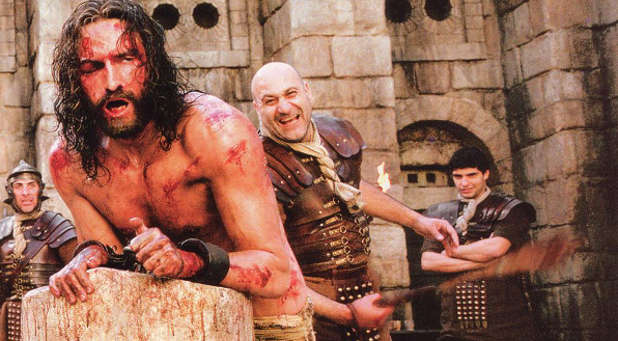
Dr. Davis: The heavy whip was brought down with full force, again and again, across Jesus’ back, shoulders, and legs. At first, the weighted thongs cut through the skin only. Then, as the blows continued, they cut deeper into the subcutaneous tissues, producing first an oozing of blood from the capillaries and veins of the skin, and finally spurting arterial bleeding from vessels in the underlying muscles.
The small balls of lead first produced large deep bruises, that were broken open by subsequent blows. The skin of the back was left hanging in long ribbons, and the entire area was an unrecognizable mass of torn, bleeding tissue. When it was determined by the centurion in charge that the prisoner was near death, the beating was finally stopped.
Jesus was then untied and allowed to slump to the stone pavement, wet with his own blood. The Roman soldiers saw a great joke in this provincial Jew claiming to be a king. They threw a robe across His shoulders and placed a stick in His hand for a scepter. Small flexible branches covered with long thorns, were plaited in the shape of a crude crown. The crown was pressed into his scalp and again there was copious bleeding as the thorns pierced the very vascular tissue. After striking Him across the face, the soldiers took the stick from His hand and struck Him across the head, driving the thorns deeper in His scalp. Finally, they tired of their sadistic sport and tore the robe from His back. The robe had already become adherent to the clots of blood and serum in the wounds, and its removal caused excruciating pain. The wounds again began to bleed.
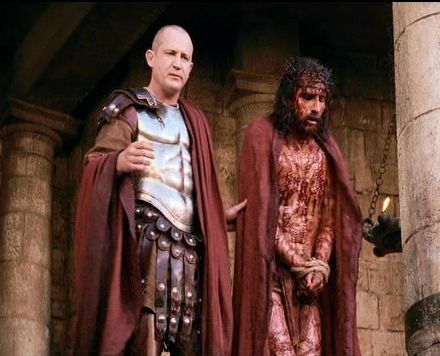
After He was sentenced to death by Pilate’s decree, the Romans returned His garments, and tied the heavy wooden cross-beam across His shoulders. The procession of the condemned Christ, two thieves, and the execution detail of Roman soldiers began its slow journey along the route which we know today as the Via Dolorosa.
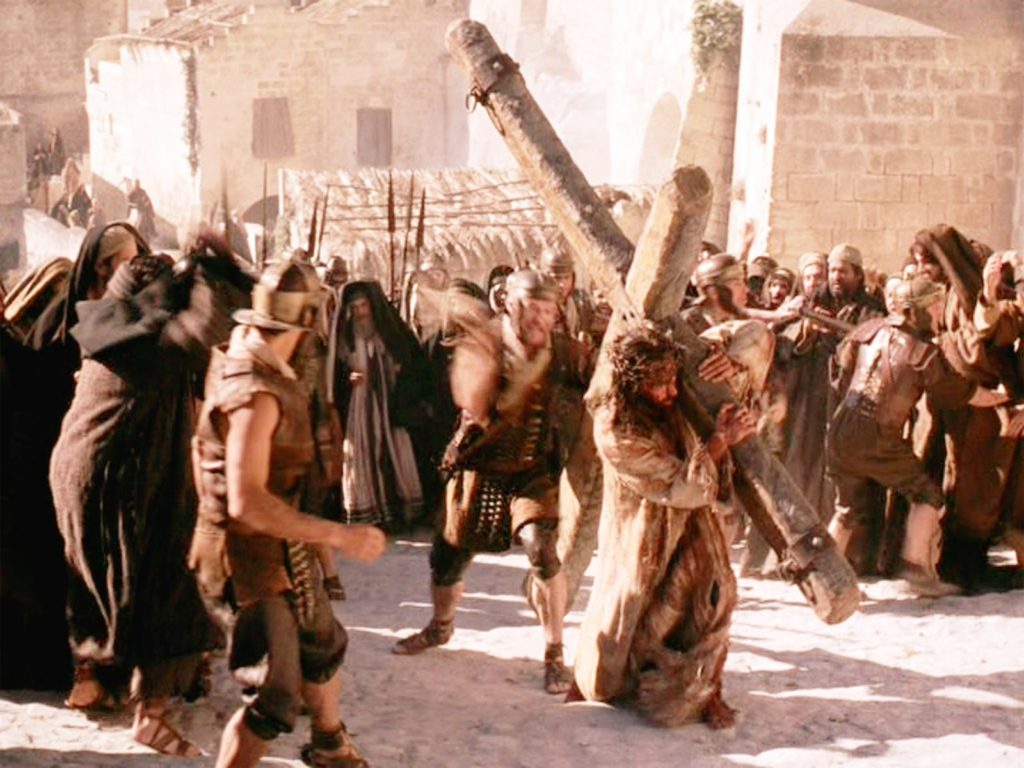
In spite of Jesus’ efforts to walk erectly, the weight of the heavy beam, and the shock produced by the loss of large amounts of blood, were too much. He stumbled and fell. The rough wood of the beam gouged into the lacerated skin and muscles of His shoulders. He tried to rise, but His muscles had been pushed beyond the limits of their endurance. So the Roman centurion forced an onlooker, Simon of Cyrene, to carry His cross. Jesus followed, continuing the 650-yard journey to Golgotha. Once there, Jesus was again stripped of His clothing except for a loin cloth.
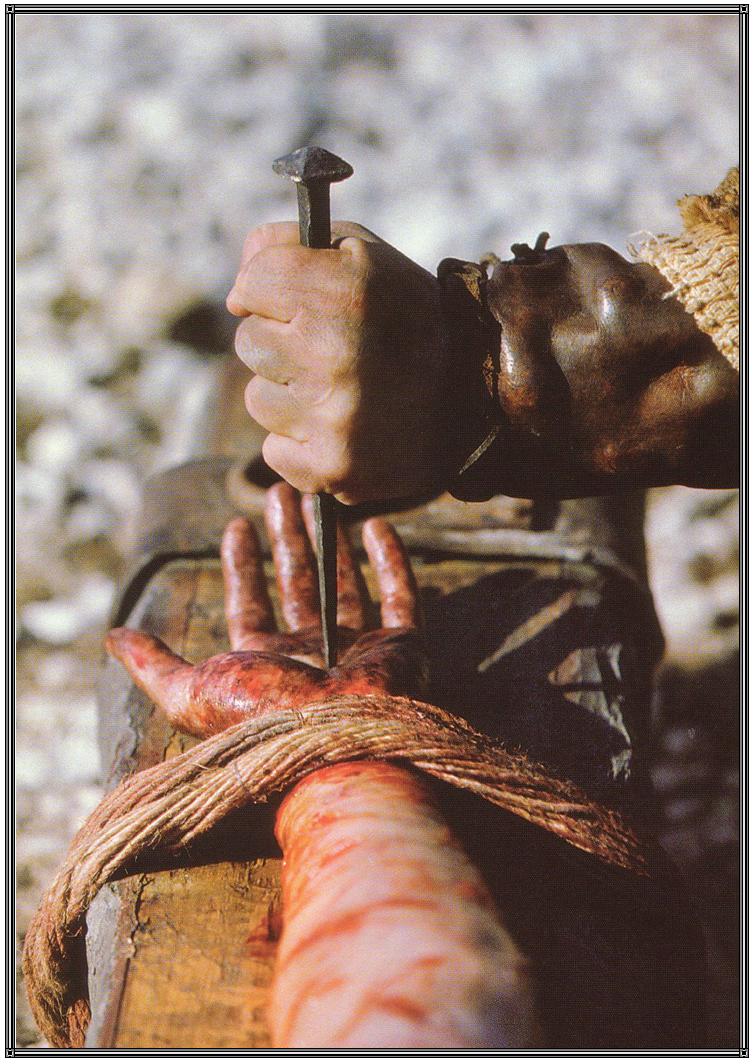
Dr. Davis: The crucifixion began. Simon was ordered to place the cross-beam on the ground, and Jesus was quickly thrown backward, with His shoulders against the wood. The soldier drove a heavy, square wrought-iron nail through one wrist and deep into the wood. Quickly, he moved to the other side and repeated the action, being careful not to pull the arms too tightly, but to allow some flexion and movement. The cross-beam was then lifted into place at the top of the upright post and the notice reading “Jesus of Nazareth, King of the Jews” was nailed into place.
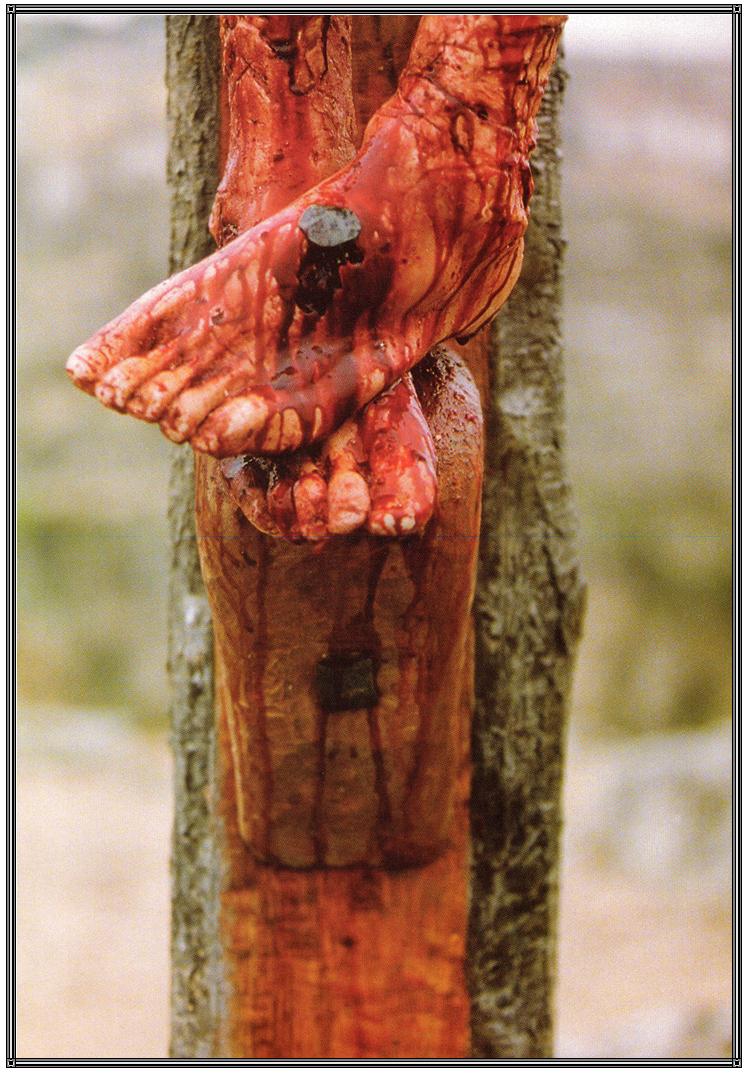
The left foot was pressed backward against the right foot. With both feet extended, toes down, a nail was driven through the arch of each, leaving the knees moderately flexed. Jesus was now crucified.
As Jesus slowly sagged down with more weight on the nails in the wrist, excruciating, fiery pain shot along His fingers and up His arms. The nails in His wrists were putting pressure on the median nerve, a large nerve trunk which traverses the mid-wrist and hand. As He pushed himself upward to avoid this stretching torment, He placed His full weight on the nail through His feet. Again there was searing agony as the nail tore through the nerves between the metatarsal bones of His feet.
At this point, another phenomenon occurred. As His arms fatigued, great waves of cramps swept over His muscles, knotting them in deep relentless, throbbing pain. With these cramps came the inability to push Himself upward. Hanging by His arms, the pectoral muscles, the large muscles of the chest, were paralyzed and the intercostal muscles, the small muscles between the ribs, were unable to act. Air could be drawn into the lungs, but could not be exhaled. Jesus fought to raise Himself in order to get even one short breath. Finally, the carbon dioxide level increased in the lungs and in the blood stream, and the cramps partially subsided.
He suffered hours of torturous pain, cycles of twisting, joint-rending cramps, intermittent partial asphyxiation, and searing pain as tissue was torn from His lacerated back from His movement up and down against the rough timbers of the cross. Then another agony began: a deep crushing pain in the chest as the pericardium slowly filled with serum fluid and began to compress His heart.
The prophecy in Psalm 22:14 was being fulfilled: “I am poured out like water, and all my bones are out of joint, my heart is like wax; it is melted in the midst of my bowels.”
Dr. Davis: The end was rapidly approaching. The loss of tissue fluids had reached a critical level; His compressed heart was struggling to pump heavy, thick, sluggish blood to the tissues, and His tortured lungs were making a frantic effort to inhale small gulps of air. His dehydrated tissues sent their desperate message to the brain. Jesus gasped “I thirst.”
Again, we read in the prophetic psalm: “My strength is dried up like a potsherd; my tongue cleaves to my jaws; and you have brought me into the dust of death.” (Psalm 22:15)
All this agonizing, all this suffering, and shame was planned and agreed upon by Jesus and His Father. But why?
“…it was because of our rebellious deeds that He was pierced and because of our sins that He was crushed. He endured the punishment that made us completely whole, and in His wounding we found our healing.” (Isaiah 53:5, TPT)
Jesus’ body was now shutting down. He could feel the chill of death creeping through His tissues. This realization brought forth a tortured whisper: “It is finished.” His mission of bearing our sins and sicknesses was completed. Finally, He could allow His body to die. With one last surge of strength, He once again pressed His torn feet against the nail, straightened His legs, took a deeper breath, and uttered His last cry: “Father, into your hands I commit my spirit.”
Dr. Davis: The common method of ending a crucifixion was breaking of the bones of the legs. This prevented the victim from pushing himself upward; the tension could not be relieved from the muscles of the chest, and rapid suffocation occurred. The legs of the two thieves were broken, but when the soldiers approached Jesus, they saw that this was unnecessary.
Apparently, to make doubly sure of His death, the soldier drove his lance between the ribs, upward through the pericardium and into His heart. John 19:34 states, “And immediately there came out blood and water.” This was a release of watery fluid from the sac surrounding the heart and the blood from the interior of the heart. Jesus died, not from suffocation, but from constriction of the heart by fluid in the pericardium.
But His suffering and death are not the end of the story! Thank God, we have a sequel! Through the Father’s love, embodied in Jesus, we can know His amazing grace, the awesome miracle of His resurrection, and the gift of our eternal salvation in Christ!
It was not the nails that held Jesus to that cross. It was love. He knew that without His suffering and death you would be forever lost, separated from God for eternity because of your sins. So He willingly and joyfully took your sin, your pain, and your punishment so you could receive His mercy. You can accept His gift of life and be resurrected, born again, into a new relationship with God as your Father right now. Simply pray this prayer from your heart as you trust in Him to save you:
“Jesus, I want to know you. Thank you for suffering and dying for me, so that I could come to the Father, and receive His forgiveness and mercy.
I declare that you are my Savior and my Lord. I invite you to enter my life right now by your Holy Spirit. I believe you. I receive you.
I am now saved! I am now born-again! And I thank you for the gift of eternal life you have given me. I will live my new life in union with you. I am yours for all eternity, beginning now.
Amen!”


 His Heart, My Home
Leave a reply to Edie Brown, MS Cancel reply