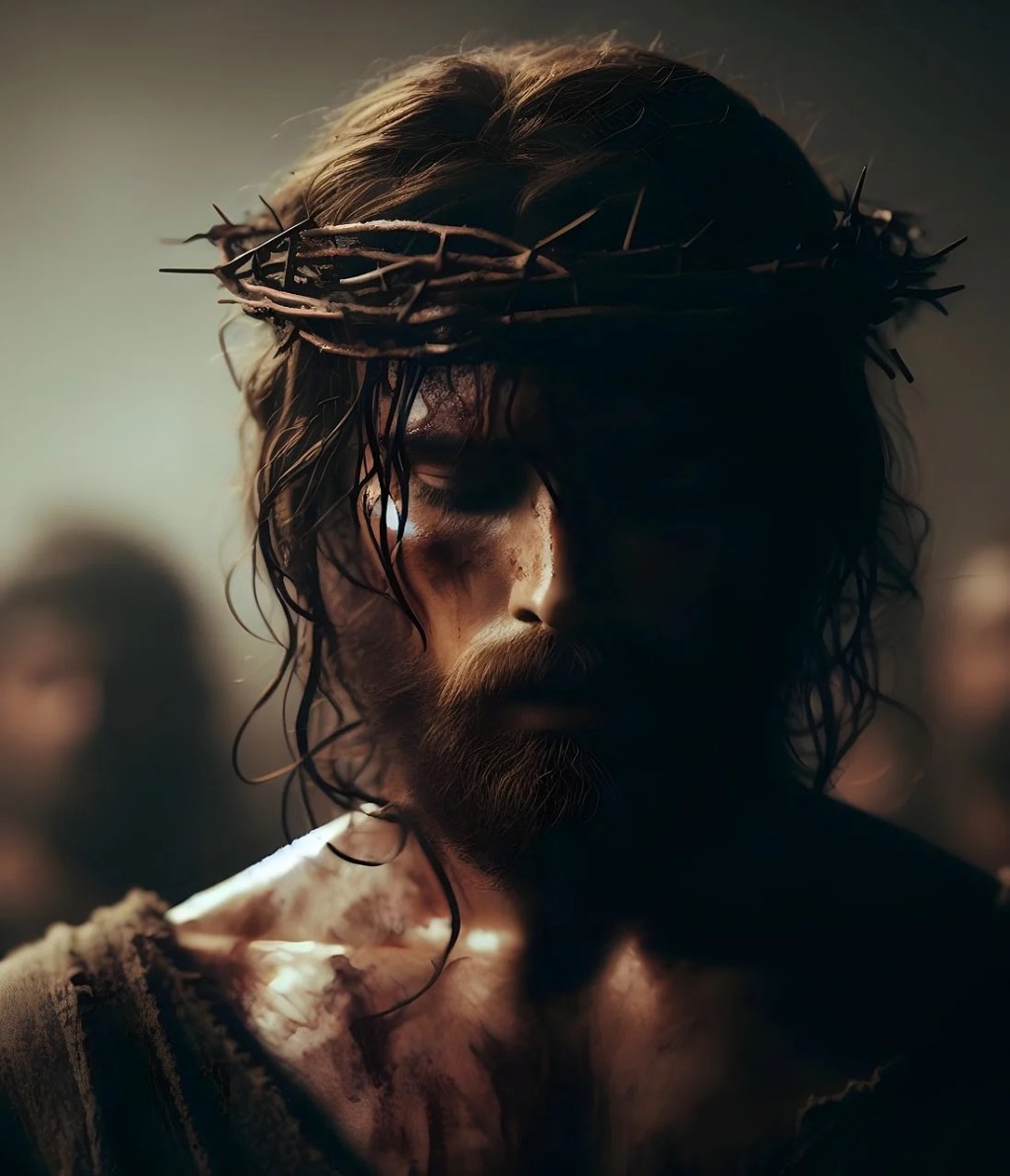
More than 700 years before Jesus was born,
the prophet Isaiah, inspired and enabled by Holy Spirit saw His substitutionary suffering and death, and recorded it for us. Isaiah, seeing by the Spirit, actually understood more of what was to take place at Calvary, than Jesus’ followers, who were physically present at the cross.
Even though the prophet’s words in Isaiah 52 and 53, are heart-rending, we should read them with a sense of wondrous awe and joyous gratitude.
Those chapters, describing what Jesus endured for us, are the heart of the gospel message. In seeing the depth of His suffering, we begin to know the height of his love.
As we study Isaiah’s prophecy concerning the Messiah’s redemptive work at Calvary, notice that the verbs used are all in the past tense in our English Bibles. More about that later.
“Surely, He has borne our griefs (sicknesses, weaknesses, and distresses) and carried our sorrows and pains [of punishment], yet we [ignorantly] considered Him stricken, smitten, and afflicted by God [as if with leprosy].”
(Isaiah 53:4, Amplified Bible, Classic Edition)
Now let’s understand why English-speaking Bible translators rendered the Hebrew words into the past tense, to describe Jesus’ suffering which would occur 700 years in the future from Isaiah’s lifetime.
In the Hebrew language, verbs do not have three tenses: past, present, and future. Instead there are only two tenses, the perfect and imperfect tenses.
The perfect tense is used to describe actions that have been completed (perfected). All other ongoing, incomplete, actions are described by the imperfect tense.
So why did Isaiah describe a future event in the life of the Messiah using perfect tense verbs, denoting completed actions? Because of the first word in Isaiah 53:4… “SURELY”.
The word translated as “surely” is the Hebrew word, “aken”. It means “yes; true; to affirm; to establish; to ordain; to stand erect; to set upright.”
The very moment that God revealed His Son’s sacrifice through Isaiah, He planted a flag in the shores of eternity, upright and erect! He affirmed established, and ordained His will for His Son for all eternity. He inspired and commanded Isaiah to say, “SURELY”! That word speaks of completion, perfection and finality, and will never pass away!
Jesus, was slain even before the foundation of creation was laid! The perfect sacrifice! He was revealed to Isaiah and given to us in the perfect tense! We have a perfectly completed salvation! Jesus’ death, burial, and resurrection completed the perfect plan of God!
“It was not a ransom payment of silver and
gold…but the precious blood of Christ, who,
like a spotless, unblemished lamb, was sacrificed for us. This was part of God’s plan, for He was chosen and destined for this before the foundation of the earth was laid…”
(1 Peter 1:18-20, Passion Translation)
SURELY! A sacred oath! A holy covenant! Ratified by the blood of God Himself that flowed in Jesus’ veins, poured out for us! It’s been done! It is finished!
There is nothing the devil, nor any circumstance, nor any person can ever do to change the words, declared and decreed forever…SURELY, He has borne and carried away those things that are life-destroying!
I’m about to jump out of my chair right now and run around the house, shouting, “Glory, glory, hallelujah!” You want to know why I’m so excited?
Because I can clearly see how we can receive our healing. All we have to do is think like God thinks and talk like God talks about our healing.
Jesus hadn’t even been born yet and God was already calling us healed. That’s the way He operates!
“And this promise is from God Himself, who makes the dead live again, and speaks of future events with as much certainty as though they were already past.”
(Romans 4:17, Living Bible)
When we speak God’s Word over our bodies and steadfastly refuse to let go of our confession, we are operating in the God-kind of faith, and we will receive our healing.
“Let us hold fast the confession of our hope without wavering, for He who promised is faithful.” (Hebrews 10:23)
WOW! We’ve only looked at one word, the first word in this verse, and God has already blessed my socks off! What else are we going to find in the rest of it?
When we read Isaiah 53:4 in the KJV or NKJV, it simply says, “…He has borne our griefs…” So some people believe this only applies to our emotional distresses, (griefs) but it means much more than that.
The Hebrew word translated as “griefs” is “choliy”. It means “sickness, disease, infirmity, malady; calamity.” The verb form of the word means “to be weak; to be feeble; to be exhausted from physical and mental anguish; to be worn down like the grinding together of teeth or stones.”
Life can sometimes feel painfully exhausting, a real “grind”, but God’s love and mercy bring deliverance, healing, and renewed strength to us. SURELY Jesus has borne (Hebrew = nasa = to endure; to lift up) our sicknesses, diseases, and infirmities.
While preparing this teaching, Holy Spirit showed me a man face down, in the mud, with a huge burden on his back, broken down, physically, mentally, and spiritually. Burdened and broken! Seemingly, he had no way out of the pain, the anguish, and the hopelessness.
As I looked at his pitiful condition, feeling compassion for him, I heard Holy Spirit say, “Surely, Jesus has borne the unbearable!” Then the scene changed. The burden was lifted. The man’s physical, mental, and spiritual anguish melted away. He was lifted out of the mud, made clean, and made whole, his faith restored, health restored, and peace restored, made perfectly whole!
That’s what this scripture is saying. Jesus lifted up the heavy burden of sickness, disease, and infirmity, a burden so heavy that we couldn’t bear it by ourselves. Jesus bore the unbearable!
The rest of the verse gives us an even deeper insight into what our Savior did. He carried our “sorrows” (Hebrew word = “makob”) which also means “anguish, pain, and agony.”
The word “carries” comes from an interesting Hebrew word (saval) which is used to describe
the work of a porter, one who carries a heavy load of baggage for another. The baggage doesn’t belong to the porter. But he still lifts up and carries its heavy weight, so it will not weigh down the traveller.
Jesus, our Burden-Bearer, invites us, ” Come unto me, all you who labor and are heavy laden, and I will give you rest…” (Matthew 11:28-30)
Jesus bore it all, our sickness, our pain, our sin, and our shame, an unbearable load, yet He bore it! Thank God, we never have to bear what He already bore for us! What a loving Savior! He is worthy of all the praise, all the honor, and all the glory, forever!
 His Heart, My Home
Leave a comment